

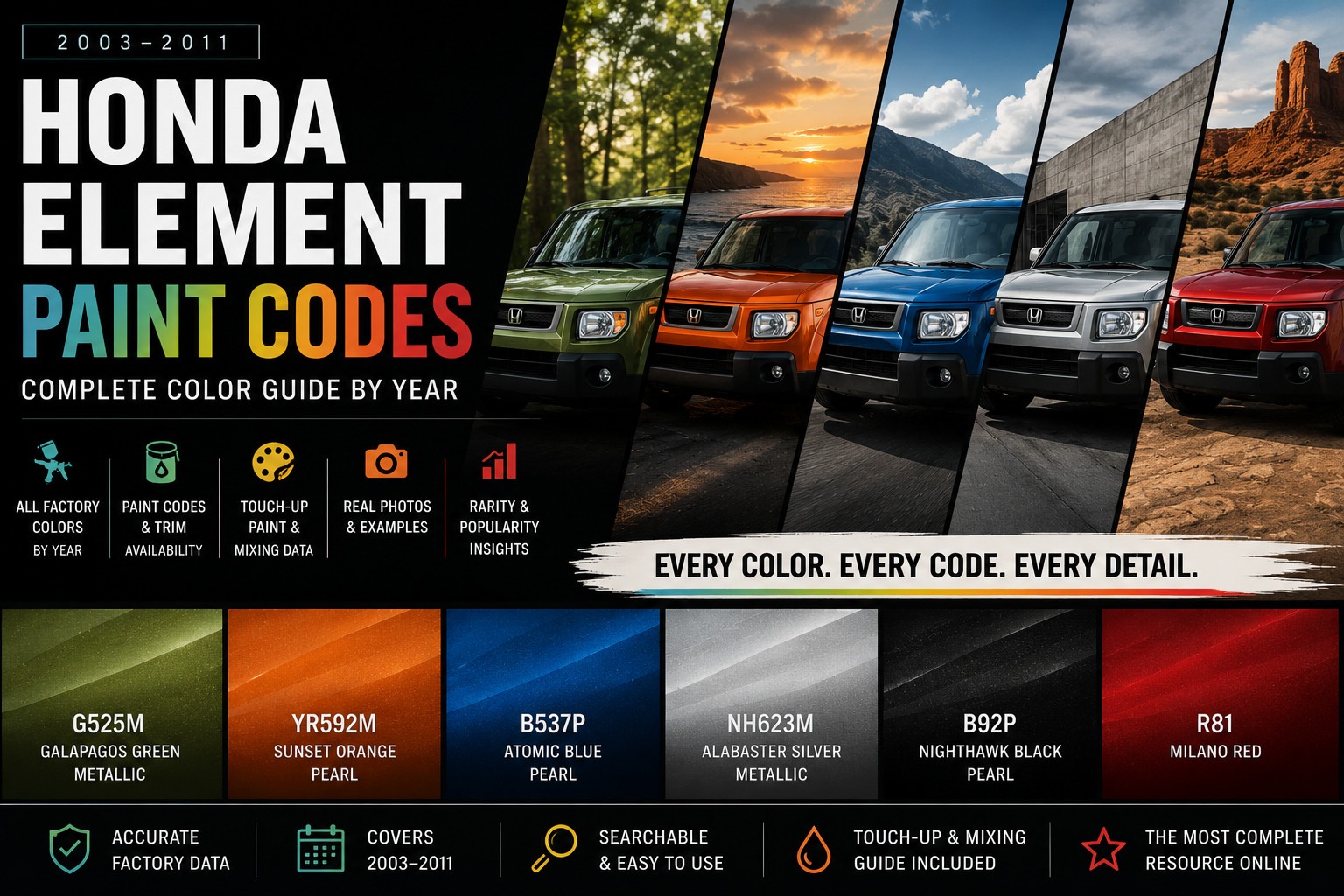
Honda Element Paint Codes: Complete Color Guide By Year
A comprehensive reference for every factory exterior paint color offered on the Honda Element from 2003 through 2011, including paint codes, trim availability, color swatches, rarity notes, and touch-up paint guidance.
Why Paint Codes Matter
When it comes to matching automotive paint, the color name printed on a brochure or listed on a dealer window sticker is almost never enough. Honda, like all major automakers, assigns a specific alphanumeric paint code to each factory color formulation. This code encodes the exact pigment ratios, metallic flake size, and pearl content required to reproduce the factory finish. Two colors that appear nearly identical under showroom lighting — such as Satin Silver Metallic (NH623M) and Alabaster Silver Metallic (NH700M) — will look noticeably different when placed side by side, and a touch-up repair made with the wrong code will stand out immediately.
The Honda Element’s nine-year production run (2003–2011) spanned 24 distinct factory exterior colors. Some colors carried over across multiple years; others appeared for a single model year and were never offered again. Trim availability further complicates the picture: certain colors were exclusive to the SC (Street Custom) trim, while others were never offered on the SC at all. Without the paint code, an owner ordering touch-up paint, a replacement door, or a full respray is essentially guessing.
Paint codes also matter for insurance claims, collision repair estimates, and resale documentation. A vehicle described accurately by its factory paint code commands more credibility in a private sale than one described only as “blue” or “silver.”
Where to Find the Paint Code
The Honda Element stores its paint code on a vehicle identification label affixed to the driver-side door jamb — the structural pillar visible when the driver’s door is open. The label is typically white or silver, rectangular in shape, and contains a barcode along with several codes printed in small text. The paint code appears below the barcode, usually in the middle section of the label.
Honda paint codes follow a consistent format: one or two letters indicating the color family, followed by three digits, and ending with a suffix letter that indicates the finish type. Common suffix letters include M (metallic), P (pearl), and no suffix for solid colors. Examples from the Element include NH-700M (Alabaster Silver Metallic), B-92P (Nighthawk Black Pearl), and YR-539P (Sunset Orange Pearl).
Several practical cautions apply when reading the door jamb sticker on a used Element. First, doors may have been swapped during a prior collision repair; if the VIN printed on the door jamb sticker does not match the VIN visible through the lower-left corner of the windshield, the door is likely a replacement and the paint code on that sticker may not reflect the vehicle’s original color. Second, repainted doors are sometimes missing the sticker entirely. In these cases, the original color can sometimes be identified from the firewall or engine bay area, where Honda occasionally stamps or labels the paint code on the body structure itself.
Master Paint Code Table
The following table lists all 24 factory exterior paint colors confirmed for the Honda Element (2003–2011), sorted alphabetically by color name. Hex and RGB values are approximations based on published color chip data and are intended as visual references only; they should not be used for paint mixing.
| Swatch | Color Name | Paint Code | Family | Years | Trims | Rarity | Notes |
|---|
Paint Codes by Year
20036 colors — all DX/LX/EX
The first model year offered six exterior colors, all available on DX, LX, and EX trims. The EX trim used unpainted textured plastic cladding panels in one of three colors depending on the body color (see Appendix A). The 2003-only Eternal Blue Pearl (B96P) makes this the rarest color in the entire Element lineup.
| Color Name | Paint Code | Trims | Notes |
|---|---|---|---|
| Eternal Blue Pearl | B96P | DX, LX, EX | 2003 only — never offered again |
| Galapagos Green Metallic | G511M | DX, LX, EX | Continued through 2005 |
| Nighthawk Black Pearl | B92P | DX, LX, EX | Continued through 2008 |
| Satin Silver Metallic | NH623M | DX, LX, EX | Continued through 2005 |
| Shoreline Mist Metallic | YR528M | DX, LX, EX | Continued through 2004 |
| Sunset Orange Pearl | YR539P | DX, LX, EX | Continued through 2005 |
20046 colors
The 2004 model year dropped Eternal Blue Pearl and replaced it with Fiji Blue Pearl (B529P), a darker navy blue. All other 2003 colors carried over. Six colors were available.
| Color Name | Paint Code | Trims | Notes |
|---|---|---|---|
| Fiji Blue Pearl | B529P | DX, LX, EX | New for 2004; replaced Eternal Blue Pearl |
| Galapagos Green Metallic | G511M | DX, LX, EX | Carried over from 2003 |
| Nighthawk Black Pearl | B92P | DX, LX, EX | Carried over from 2003 |
| Satin Silver Metallic | NH623M | DX, LX, EX | Carried over from 2003 |
| Shoreline Mist Metallic | YR528M | DX, LX, EX | Final year |
| Sunset Orange Pearl | YR539P | DX, LX, EX | Carried over from 2003 |
20058 colors — most colorful early year
The 2005 model year was the most colorful of the early generation, offering eight colors. Two of the three single-year Element colors appeared in 2005: Cargo Khaki (YR547) and Magnesium Metallic (NH675M). Rallye Red (R513) was introduced for the first time.
| Color Name | Paint Code | Trims | Notes |
|---|---|---|---|
| Cargo Khaki | YR547 | DX, LX, EX | 2005 only — single-year color |
| Fiji Blue Pearl | B529P | DX, LX, EX | Final year |
| Galapagos Green Metallic | G511M | DX, LX, EX | Final year |
| Magnesium Metallic | NH675M | DX, LX, EX | 2005 only — single-year color |
| Nighthawk Black Pearl | B92P | DX, LX, EX | Carried over |
| Rallye Red | R513 | DX, LX, EX | New for 2005 |
| Satin Silver Metallic | NH623M | DX, LX, EX | Final year |
| Sunset Orange Pearl | YR539P | DX, LX, EX | Final year |
20067 colors — palette refresh
The 2006 model year marked a significant palette refresh. The early-generation colors (Satin Silver, Galapagos Green, Sunset Orange, Shoreline Mist) were retired, and several new colors were introduced. Alabaster Silver Metallic (NH700M) replaced Satin Silver and would remain in the lineup through 2011. Seven colors were available.
| Color Name | Paint Code | Trims | Notes |
|---|---|---|---|
| Alabaster Silver Metallic | NH700M | DX, LX, EX | New for 2006; ran through 2011 |
| Atomic Blue Metallic | B537M | LX, EX | New for 2006 |
| Kiwi Metallic | GY25M | LX, EX | New for 2006 |
| Nighthawk Black Pearl | B92P | DX, LX, EX | Carried over |
| Rallye Red | R513 | DX, LX, EX | Final year |
| Tango Red Pearl | R525P | LX, EX | New for 2006; ran through 2011 |
| Tangerine Metallic | YR5863M | LX, EX | New for 2006 |
20078 colors — SC trim debuts
The 2007 model year introduced the SC (Street Custom) trim, which brought two SC-exclusive colors: Root Beer Metallic (YR569M) and Galaxy Gray Metallic (NH701M) — though Galaxy Gray was also available on LX and EX. Eight colors were available across all trims.
| Color Name | Paint Code | Trims | Notes |
|---|---|---|---|
| Alabaster Silver Metallic | NH700M | DX, LX, EX, SC | SC debut year |
| Atomic Blue Metallic | B537M | LX, EX | Carried over |
| Galaxy Gray Metallic | NH701M | LX, EX, SC | New for 2007 |
| Kiwi Metallic | GY25M | LX, EX | Carried over |
| Nighthawk Black Pearl | B92P | DX, LX, EX, SC | Carried over |
| Root Beer Metallic | YR569M | SC only | New for 2007; SC-exclusive |
| Tango Red Pearl | R525P | LX, EX | Carried over |
| Tangerine Metallic | YR5863M | LX, EX | Carried over |
20089 colors — most color-diverse year
The 2008 model year was the most color-diverse in Element history, offering nine colors. Royal Blue Pearl (B536P) was introduced as an SC-exclusive color. This was also the final year for Nighthawk Black Pearl, Atomic Blue Metallic, Kiwi Metallic, Galaxy Gray Metallic, Root Beer Metallic, and Tangerine Metallic.
| Color Name | Paint Code | Trims | Notes |
|---|---|---|---|
| Alabaster Silver Metallic | NH700M | DX, LX, EX, SC | Carried over |
| Atomic Blue Metallic | B537M | LX, EX | Final year |
| Galaxy Gray Metallic | NH701M | LX, EX, SC | Final year |
| Kiwi Metallic | GY25M | LX, EX | Final year |
| Nighthawk Black Pearl | B92P | DX, LX, EX, SC | Final year |
| Root Beer Metallic | YR569M | SC only | Final year |
| Royal Blue Pearl | B536P | SC only | New for 2008; SC-exclusive this year only |
| Tango Red Pearl | R525P | LX, EX | Carried over |
| Tangerine Metallic | YR5863M | LX, EX | Final year |
20098 colors — final-gen refresh
The 2009 model year brought a major palette refresh for the final generation. Crystal Black Pearl (NH731P) replaced Nighthawk Black Pearl, Polished Metal Metallic (NH737M) and Omni Blue Pearl (B562P) were introduced, and Citrus Fire Metallic (YR579M) replaced Tangerine Metallic. On the SC, Midnight Red Pearl (R538P) replaced Root Beer Metallic, and Royal Blue Pearl expanded to all trims. Eight colors were available.
| Color Name | Paint Code | Trims | Notes |
|---|---|---|---|
| Alabaster Silver Metallic | NH700M | DX, LX, EX, SC | Carried over |
| Citrus Fire Metallic | YR579M | LX, EX | New for 2009 |
| Crystal Black Pearl | NH731P | LX, EX | New; replaced Nighthawk Black Pearl |
| Midnight Red Pearl | R538P | SC only | New for 2009; SC-exclusive |
| Omni Blue Pearl | B562P | LX, EX | New for 2009 |
| Polished Metal Metallic | NH737M | LX, EX | New for 2009 |
| Royal Blue Pearl | B536P | LX, EX, SC | Expanded from SC-only to all trims |
| Tango Red Pearl | R525P | LX, EX | Carried over |
20109 colors — most colorful final-gen year
The 2010 model year was nearly identical to 2009, with one addition: Taffeta White (NH578) joined the lineup for the first time. Nine colors were available, making 2010 the most colorful of the final-generation years.
| Color Name | Paint Code | Trims | Notes |
|---|---|---|---|
| Alabaster Silver Metallic | NH700M | DX, LX, EX, SC | Carried over |
| Citrus Fire Metallic | YR579M | LX, EX | Carried over |
| Crystal Black Pearl | NH731P | LX, EX | Carried over |
| Midnight Red Pearl | R538P | SC only | Final year |
| Omni Blue Pearl | B562P | LX, EX | Carried over |
| Polished Metal Metallic | NH737M | LX, EX | Carried over |
| Royal Blue Pearl | B536P | LX, EX, SC | Final year for SC; final year overall |
| Taffeta White | NH578 | LX, EX | New for 2010 |
| Tango Red Pearl | R525P | LX, EX | Carried over |
20117 colors — final model year
The final model year of the Honda Element offered seven colors. The SC trim was discontinued after 2010, so all 2011 colors were available on LX and EX only. Alabaster Silver Metallic remained the sole color available on the DX trim.
| Color Name | Paint Code | Trims | Notes |
|---|---|---|---|
| Alabaster Silver Metallic | NH700M | DX, LX, EX | Final year; ran 2006–2011 |
| Citrus Fire Metallic | YR579M | LX, EX | Final year |
| Crystal Black Pearl | NH731P | LX, EX | Final year |
| Omni Blue Pearl | B562P | LX, EX | Final year |
| Polished Metal Metallic | NH737M | LX, EX | Final year |
| Taffeta White | NH578 | LX, EX | Final year |
| Tango Red Pearl | R525P | LX, EX | Final year; ran 2006–2011 |
Paint Codes by Color Family
Black
Two distinct blacks were offered across the Element’s production run. Nighthawk Black Pearl (B92P) served the first six years and is a very deep, slightly warm black with subtle pearl. Crystal Black Pearl (NH731P) took over for the final three years and has a cooler, blue-tinged depth. Both appear nearly identical in photographs but are noticeably different when matched side by side.
| Color Name | Paint Code | Years |
|---|---|---|
| Crystal Black Pearl | NH731P | 2009–2011 |
| Nighthawk Black Pearl | B92P | 2003–2008 |
Blue
The Element offered six distinct blue colors across its production run — more than any other color family. Blues ranged from the deep cobalt of Eternal Blue Pearl to the unusual color-shifting Omni Blue Pearl.
| Color Name | Paint Code | Years |
|---|---|---|
| Atomic Blue Metallic | B537M | 2006–2008 |
| Eternal Blue Pearl | B96P | 2003 only |
| Fiji Blue Pearl | B529P | 2004–2005 |
| Omni Blue Pearl | B562P | 2009–2011 |
| Royal Blue Pearl | B536P | 2008–2010 |
Brown
Root Beer Metallic (YR569M) is the only brown offered on the Element, and it was exclusive to the SC trim.
| Color Name | Paint Code | Years |
|---|---|---|
| Root Beer Metallic | YR569M | 2007–2008 (SC only) |
Gray
Three gray tones appeared across the Element’s run, progressing from the warm Magnesium Metallic of 2005 to the warm-brown Galaxy Gray of 2007–2008 to the darker, cooler Polished Metal Metallic of the final years.
| Color Name | Paint Code | Years |
|---|---|---|
| Galaxy Gray Metallic | NH701M | 2007–2008 |
| Magnesium Metallic | NH675M | 2005 only |
| Polished Metal Metallic | NH737M | 2009–2011 |
Green
Two greens bookended the Element’s palette: the sage-toned Galapagos Green Metallic of the early years and the bold, yellow-green Kiwi Metallic of the middle years.
| Color Name | Paint Code | Years |
|---|---|---|
| Galapagos Green Metallic | G511M | 2003–2005 |
| Kiwi Metallic | GY25M | 2006–2008 |
Orange
Orange was a signature color family for the Element throughout its entire production run, with a distinct orange offered in every year from 2003 to 2011.
| Color Name | Paint Code | Years |
|---|---|---|
| Citrus Fire Metallic | YR579M | 2009–2011 |
| Sunset Orange Pearl | YR539P | 2003–2005 |
| Tangerine Metallic | YR5863M | 2006–2008 |
Red
The Element offered three distinct reds. Rallye Red is a classic, solid Honda red; Tango Red Pearl is a deeper, more sophisticated pearl red; and Midnight Red Pearl is a very dark, almost maroon SC-exclusive.
| Color Name | Paint Code | Years |
|---|---|---|
| Midnight Red Pearl | R538P | 2009–2010 (SC only) |
| Rallye Red | R513 | 2005–2006 |
| Tango Red Pearl | R525P | 2006–2011 |
Silver
Two silvers were offered, with Satin Silver Metallic serving the early years and Alabaster Silver Metallic — a slightly warmer, more complex metallic — taking over from 2006 onward.
| Color Name | Paint Code | Years |
|---|---|---|
| Alabaster Silver Metallic | NH700M | 2006–2011 |
| Satin Silver Metallic | NH623M | 2003–2005 |
Tan/Beige
Two earth-toned colors appeared in the early years: Shoreline Mist Metallic (a warm taupe) and Cargo Khaki (a medium brown-tan). Neither was offered after 2005.
| Color Name | Paint Code | Years |
|---|---|---|
| Cargo Khaki | YR547 | 2005 only |
| Shoreline Mist Metallic | YR528M | 2003–2004 |
White
Taffeta White was the only white offered on the Element, and it was introduced only in the final two years of production.
| Color Name | Paint Code | Years |
|---|---|---|
| Taffeta White | NH578 | 2010–2011 |
Rarest Honda Element Colors
Rarity is determined by two factors: the number of model years a color was offered, and whether it was restricted to a specific trim. The following colors are the hardest to find in the used market.
Eternal Blue Pearl (B96P) — 2003 only. This is the single rarest non-SC color in the entire Element lineup. Offered only in the first model year, it is a rich cobalt blue with a warm pearl shimmer. Community discussions on the Honda Element Owners Club confirm it as one of the three single-year Element colors.
Midnight Red Pearl (R538P) — 2009–2010 SC only. The darkest red offered on the Element, this near-maroon SC-exclusive is widely considered the rarest color in the entire lineup when combined with its SC-only restriction. The SC itself was a low-volume trim, and Midnight Red Pearl was one of its most distinctive options.
Root Beer Metallic (YR569M) — 2007–2008 SC only. A warm, deep brown metallic exclusive to the SC trim. This color is beloved by SC enthusiasts and is extremely difficult to find in good condition. It was paired with the SC’s copper-accented interior option, making for a uniquely cohesive color story.
Cargo Khaki (YR547) — 2005 only. A medium brown-tan that appeared for a single year on all trims. While not as sought-after as the SC exclusives, it is genuinely rare due to its single-year availability.
Magnesium Metallic (NH675M) — 2005 only. A medium warm gray that appeared for a single year. Like Cargo Khaki, it is one of the three confirmed single-year Element colors.
| Color Name | Paint Code | Year(s) | Trim Restriction | Rarity |
|---|---|---|---|---|
| Eternal Blue Pearl | B96P | 2003 | None | Very Rare |
| Midnight Red Pearl | R538P | 2009–2010 | SC only | Very Rare |
| Root Beer Metallic | YR569M | 2007–2008 | SC only | Very Rare |
| Cargo Khaki | YR547 | 2005 | None | Rare |
| Magnesium Metallic | NH675M | 2005 | None | Rare |
| Royal Blue Pearl | B536P | 2008–2010 | SC only in 2008 | Rare |
Most Desirable Honda Element Colors
Desirability in the collector and enthusiast community is driven by a combination of visual uniqueness, rarity, and the color’s association with the Element’s identity as a rugged, personality-driven vehicle.
Omni Blue Pearl (B562P) consistently ranks among the most sought-after late-model Element colors. Its unusual chameleon-like quality — appearing blue in direct sunlight but shifting toward green or gray in overcast conditions — is unlike any other color in the Honda palette. Community members affectionately call it “Ghost Green.” It was offered on LX and EX trims from 2009 to 2011.
Sunset Orange Pearl (YR539P) and Galapagos Green Metallic (G511M) are the two colors most closely associated with the Element’s original identity. Both were offered from 2003 to 2005 and appeared extensively in Honda’s early marketing for the vehicle. They remain the most recognizable Element colors and are highly desirable to collectors seeking an authentic early-generation example.
Root Beer Metallic (YR569M) and Midnight Red Pearl (R538P) are the two most desirable SC-specific colors. Their combination of rarity, SC-exclusivity, and visual distinctiveness makes them the most collectible colors in the entire Element lineup.
Crystal Black Pearl (NH731P) is the most-ordered Element touch-up color according to PaintScratch sales data, reflecting both its popularity and the large number of late-model Elements still on the road. It is a deep, blue-tinged black pearl that photographs exceptionally well.
| Color Name | Paint Code | Why Desirable |
|---|---|---|
| Crystal Black Pearl | NH731P | Most popular late-model color; deep blue-black pearl |
| Galapagos Green Metallic | G511M | Iconic early Element color; collector favorite |
| Midnight Red Pearl | R538P | Rarest SC color; very dark maroon |
| Omni Blue Pearl | B562P | Unique color-shifting appearance; “Ghost Green” |
| Root Beer Metallic | YR569M | SC-exclusive; uniquely warm brown; highly collectible |
| Royal Blue Pearl | B536P | Deep navy; SC-exclusive in 2008 |
| Sunset Orange Pearl | YR539P | Iconic early Element color; original identity |
SC-Only and SC-Associated Colors
The Honda Element SC (Street Custom) was offered from 2007 through 2010. It featured a lowered suspension, 18-inch alloy wheels, body-color painted lower panels (eliminating the unpainted plastic cladding of standard trims), a unique front fascia, and a sport-tuned interior. The SC’s fully painted exterior meant that its colors had a fundamentally different visual character than the same color on a standard EX with unpainted cladding.
Three colors were exclusive to the SC trim:
Root Beer Metallic (YR569M) — 2007–2008 SC only. A warm, deep brown metallic with gold undertones. On the SC’s fully painted panels, it presents as a rich, jewel-like finish. It was paired with the SC’s optional Black/Copper interior (YR355L Copper Metallic upholstery). It was also used on the Honda Accord Hybrid in 2007–2008, making it one of the few Element colors shared with another Honda model.
Midnight Red Pearl (R538P) — 2009–2010 SC only. An extremely dark, near-maroon red pearl. On the SC’s painted panels, it reads as almost black in low light and reveals its deep red character in direct sunlight. It was paired with the SC’s Black/Red Metal interior option (R166L SC Red Metallic upholstery).
Royal Blue Pearl (B536P) — 2008 SC only (expanded to all trims in 2009–2010). A deep, saturated navy blue pearl. In its 2008 SC-only year, it was one of the most visually striking configurations available on any Honda vehicle of the era. When it expanded to LX and EX trims in 2009, it lost its SC-exclusive status but remained a popular choice.
Several other colors were available on the SC alongside standard trims:
| Color Name | Paint Code | SC Years |
|---|---|---|
| Alabaster Silver Metallic | NH700M | 2007–2010 |
| Galaxy Gray Metallic | NH701M | 2007–2008 |
| Nighthawk Black Pearl | B92P | 2007–2008 |
| Royal Blue Pearl | B536P | 2009–2010 (all trims) |
Touch-Up Paint Buying Guide
Understanding the Basecoat/Clearcoat System
All Honda Elements from 2003 to 2011 were painted at the factory using a basecoat/clearcoat system. The basecoat provides the color; the clearcoat provides gloss, depth, and UV protection. When purchasing touch-up paint, you need both components for a complete repair. Most reputable touch-up paint suppliers (PaintScratch, AutomotiveTouchup, ERA Paints, TouchUpDirect) sell kits that include both.
Step 1: Identify Your Paint Code
Always use the paint code from your door jamb sticker. Never order by color name alone. If your sticker is missing or illegible, cross-reference your VIN with a Honda dealer or use the year-by-year tables in this guide to narrow down the possibilities.
Step 2: Understand Code Suffixes
Some Honda paint codes include a numeric suffix (e.g., NH700M-4). This suffix indicates a factory reformulation — typically a slight adjustment to the metallic flake or pigment ratio made during the production run. For touch-up purposes, the base code (e.g., NH700M) is usually sufficient for a good match, but providing the full code including the suffix to your paint supplier will yield the most accurate result.
Step 3: Choose the Right Product Format
Touch-up paint is available in several formats, each suited to different repair sizes:
| Format | Best For | Skill Level |
|---|---|---|
| Paint pen | Chips up to pencil-eraser size | Beginner |
| Bottle with brush | Chips up to dime size | Beginner–Intermediate |
| Aerosol spray can | Single-panel repairs | Intermediate–Advanced |
| Professional spray gun | Full repaints | Professional |
Step 4: Special Considerations for Plastic Cladding
If your Element has unpainted textured plastic cladding panels (standard on EX trim 2003–2006), do not apply standard body paint directly to the plastic. The plastic requires an adhesion promoter, a flexible bumper primer, the color basecoat matched to the cladding code (NH533, B535M, or NH661), and a flexible clearcoat. If you are converting unpainted panels to body-color painted panels (a popular modification), the same process applies but uses the body paint code instead of the cladding code.
Touch-Up Paint Suppliers
The following suppliers are known to carry Honda Element colors with verified OEM color matching:
| Supplier | URL | Notes |
|---|---|---|
| PaintScratch | paintscratch.com | Custom-mixed; 30 Element colors listed |
| AutomotiveTouchup | automotivetouchup.com | Year-specific color selection |
| ERA Paints | erapaints.com | Aerosol and spray gun sizes |
| TouchUpDirect | touchupdirect.com | OEM-matched formulations |
| The Touch Up Shop | thetouchupshop.com | Year/code-specific ordering |
Frequently Asked Questions
What is the most common Honda Element color?
Alabaster Silver Metallic (NH700M) was offered for six consecutive years (2006–2011) across all trims including the SC, making it statistically the most common color in the used Element market. Nighthawk Black Pearl (B92P) was offered for six years as well (2003–2008) and is equally common in early-generation examples.
What is the rarest Honda Element color?
Eternal Blue Pearl (B96P) is the rarest non-SC color, having been offered only in 2003. Among all colors including SC-exclusives, Midnight Red Pearl (R538P) and Root Beer Metallic (YR569M) are considered the rarest due to their combination of SC-only restriction and two-year availability.
What is the difference between Nighthawk Black Pearl and Crystal Black Pearl?
Both appear very dark, but they are distinct formulations. Nighthawk Black Pearl (B92P) has a warmer, slightly less blue character and was used across the Honda lineup from the late 1990s through the mid-2000s. Crystal Black Pearl (NH731P) has a cooler, deeper blue-black character with more pronounced pearl shimmer. They are not interchangeable for touch-up purposes.
Why does my Omni Blue Pearl look green?
Omni Blue Pearl (B562P) is a color-shifting paint that appears blue in direct sunlight and shifts toward green or gray in overcast or indirect lighting. This is an intentional characteristic of the formulation, not a defect. The community nickname “Ghost Green” reflects this behavior.
Can I use touch-up paint on the plastic cladding panels?
Standard body touch-up paint will not adhere properly to the unpainted textured plastic cladding without an adhesion promoter. See Section 9 for the correct preparation process. If your cladding has faded (a common issue on 2003–2006 models), plastic restoration products such as trim restorers can revive the appearance without painting.
My Element has a color not listed here. What should I do?
Verify the paint code on your door jamb sticker and cross-reference it with the year-by-year tables in this guide. Some Elements were sold with dealer-applied paint or were repainted by a prior owner. If the code on your sticker does not match any color in this guide, the vehicle may have been repainted. You can also contact a Honda dealer with your VIN to request the original factory color.
Are Honda Element paint codes shared with other Honda models?
Yes. Several Element paint codes were used across the broader Honda lineup. Nighthawk Black Pearl (B92P) was used on CR-V, Pilot, Accord, Civic, Odyssey, and Ridgeline, among others. Alabaster Silver Metallic (NH700M) was used on CR-V, Pilot, and Accord. Root Beer Metallic (YR569M) was shared with the Accord Hybrid in 2007–2008. This means touch-up paint for these codes is widely available and often less expensive than codes specific to the Element.
Where else might the paint code appear on my Element?
In addition to the driver-side door jamb sticker, Honda sometimes stamps or labels the paint code on the firewall inside the engine bay. This is not universal across all model years, but it can be a useful backup if the door jamb sticker is missing or illegible.
What is the difference between the EX and EX-P trim regarding paint?
The standard EX trim (primarily 2003–2006) used unpainted textured composite exterior panels molded in one of three cladding colors (NH533, B535M, or NH661). The EX-P package replaced these with body-color painted composite panels using the same paint code as the steel body panels. The EX-P provides a more conventional, monochromatic appearance but is more susceptible to scratches and clear-coat aging than the textured unpainted panels.
Appendix A: Exterior Plastic Panel (Cladding) Color Codes
Early Honda Element models (primarily 2003–2006 EX trim) used unpainted textured composite exterior panels. These panels were molded in color and used separate codes from the body paint. The EX-P package (available in later years) replaced these with body-color painted panels using the same code as the steel body panels.
| Code | Name | Description | Paired With |
|---|---|---|---|
NH533 | Bumper Dark Gray | Charcoal (often described as black, but actually dark charcoal) | Atomic Blue Metallic, Kiwi Metallic, Nighthawk Black Pearl, Rallye Red |
B535M | Blue Metallic | Subtle blue-tinted textured plastic | Alabaster Silver Metallic, Satin Silver Metallic |
NH661 | EX Warm Gray | Warm gray; default for all other colors | All other 2003–2006 colors with unpainted panels |
Appendix B: Interior Color Codes by Year
Honda Element interior color codes are also found on the door jamb sticker, typically adjacent to the exterior paint code.
| Year/Trim | Code | Interior Color | Upholstery Code | Upholstery Color |
|---|---|---|---|---|
| 2003–2005 all | A | Black/Gray | NH361L | CF Gray |
| 2003–2005 all | B | Gray/Blue | B137L | Surf Blue |
| 2003–2005 all | C | Gray/Green | G60L | Field Green |
| 2006 all | A | Black/Gray | NH361L | CF Gray |
| 2006 all | B | Gray/Blue | B137L | Surf Blue |
| 2007–2008 LX, EX | A | Black/Gray | NH361L | CF Gray |
| 2007–2008 LX, EX | B | Black/Titanium | YR233L | Titanium |
| 2007–2008 SC | C | Black/Titanium | YR233L | Titanium |
| 2007–2008 SC | D | Black/Copper | YR355L | Copper Metallic |
| 2009–2010 LX, EX | A | Black/Gray | NH598L | Atlas Gray |
| 2009–2010 LX, EX | B | Black/Titanium | YR233L | Titanium |
| 2009–2010 SC | C | Black/Titanium | YR233L | Titanium |
| 2009–2010 SC | D | Black/Red Metal | R166L | SC Red Metallic |
| 2010–2011 all | A | Black/Gray | NH598L | Atlas Gray |
| 2010–2011 all | B | Black/Titanium | YR233L | Titanium |
References
- Production numbers by paint code — Honda Element Owners Club
- Rarest Honda Element color discussion — Facebook
- Omni Blue Pearl color discussion — Facebook Element Classifieds
- Honda Element Touch Up Paint (30 OEM Colors) — PaintScratch
- Honda Element Color Codes — RamblerDan
- Paint Colors & Codes (2003–2011) — ElementDIY
- Honda Element (2003–2011) Paint Colors and Brochures — ImportArchive
- Honda Touch Up Paint by Year — AutomotiveTouchup
- Honda Element Colors by Year — CarsDirect